
By Scott Etkin
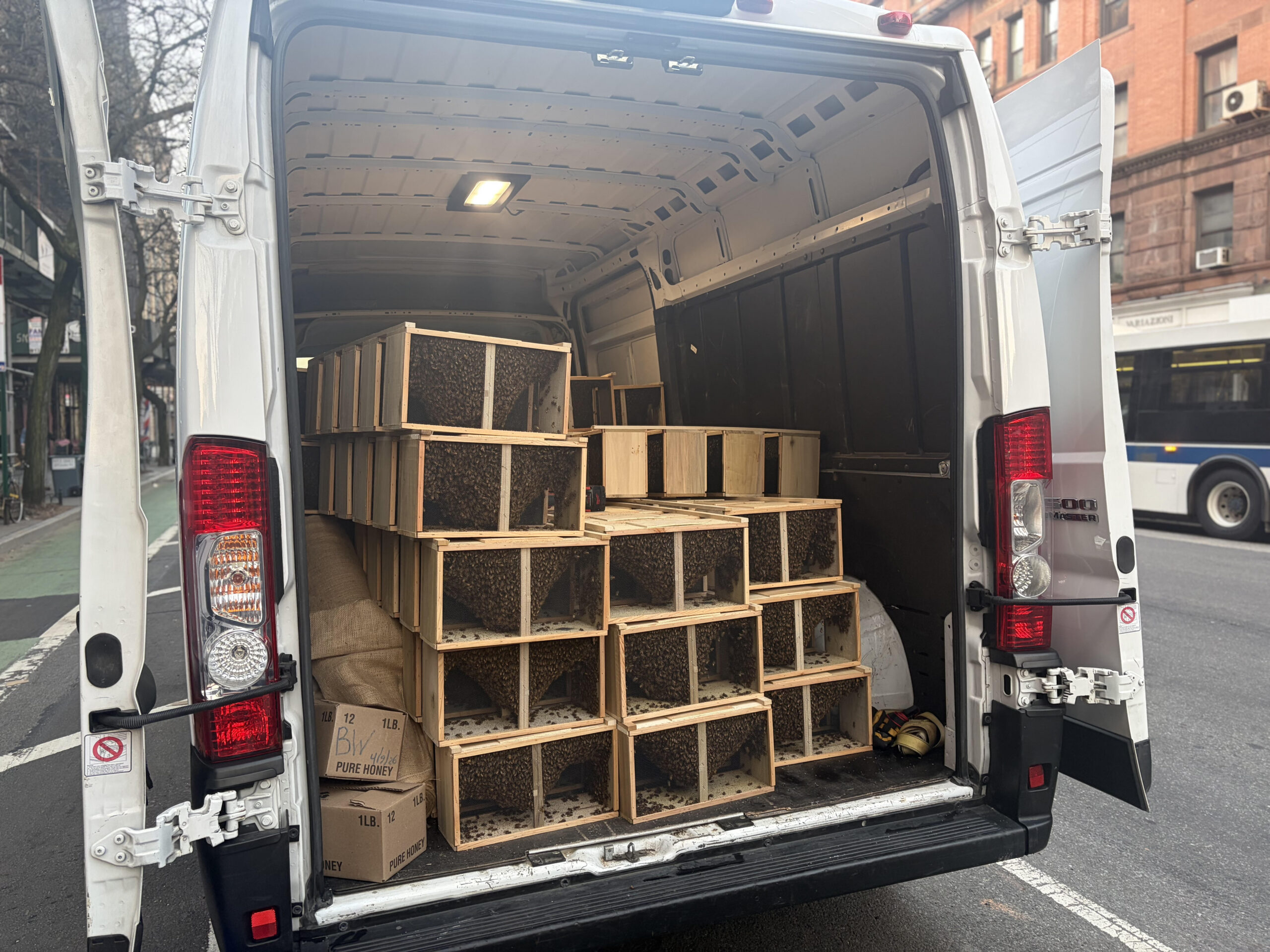
At just past 6:45 a.m. on a chilly Friday, Andrew Coté started unloading boxes of bees from the back of a white rental van parked on the Upper West Side.
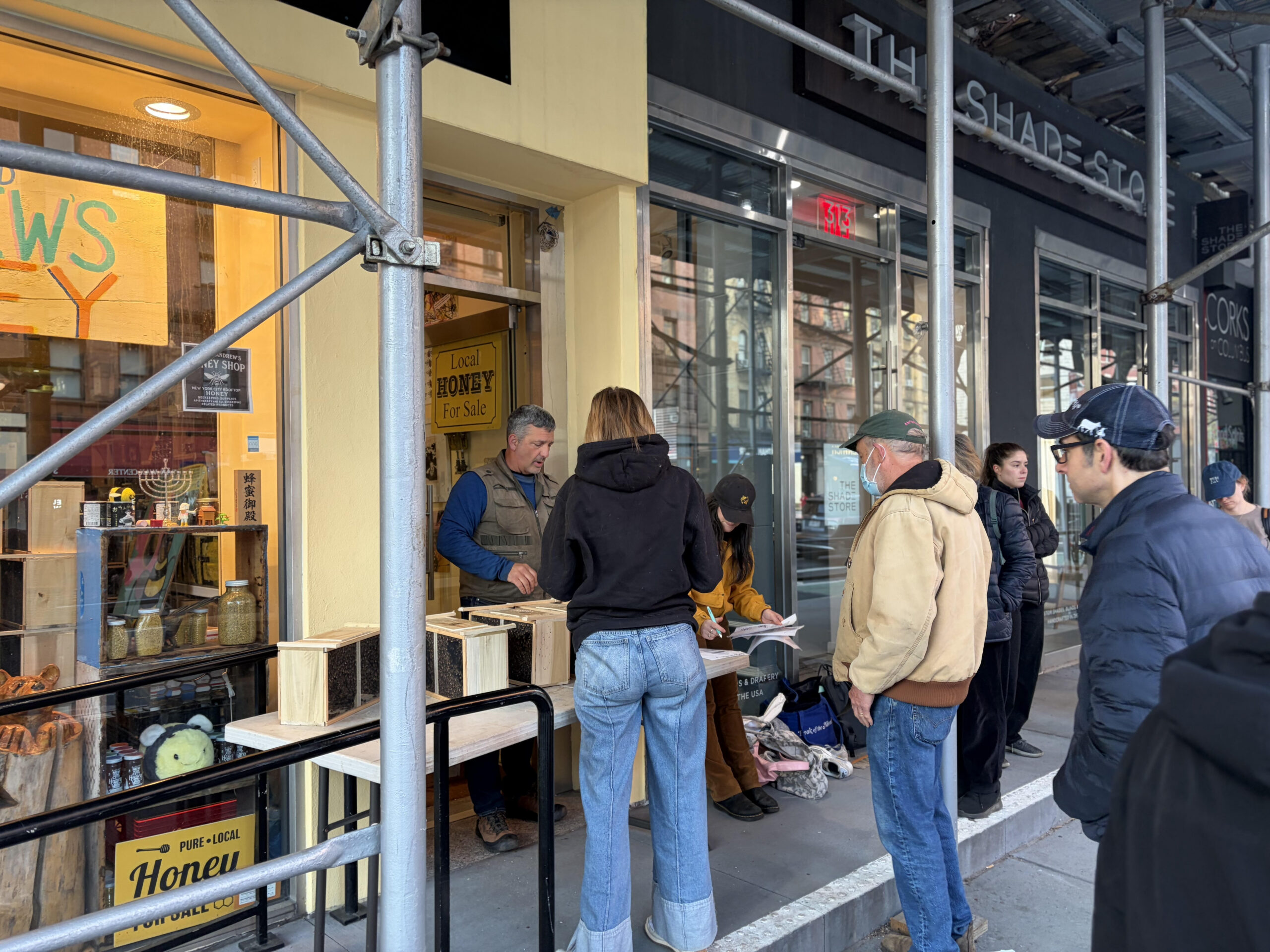
Beekeeping apprentices, some dressed in protective bee suits, others in sweatpants or jeans, brushed stray bees from the outside of the boxes, and then brought the wooden containers into Andrew’s Honey on the corner of West 75th Street and Columbus Avenue.
The shop, which sells many types of local honey, was the site of this year’s distribution of live bees to dozens of beekeepers in the city. Coté has held this event – affectionately called “the running of the bees” – for the past 20 years in various locations, including Bryant Park and Columbus Circle.
A group of beekeepers and onlookers gathered around the store, taking photos and talking about their hives. Each box contained its own queen, though she was kept in a smaller, separate enclosure while the worker bees got used to her scent.
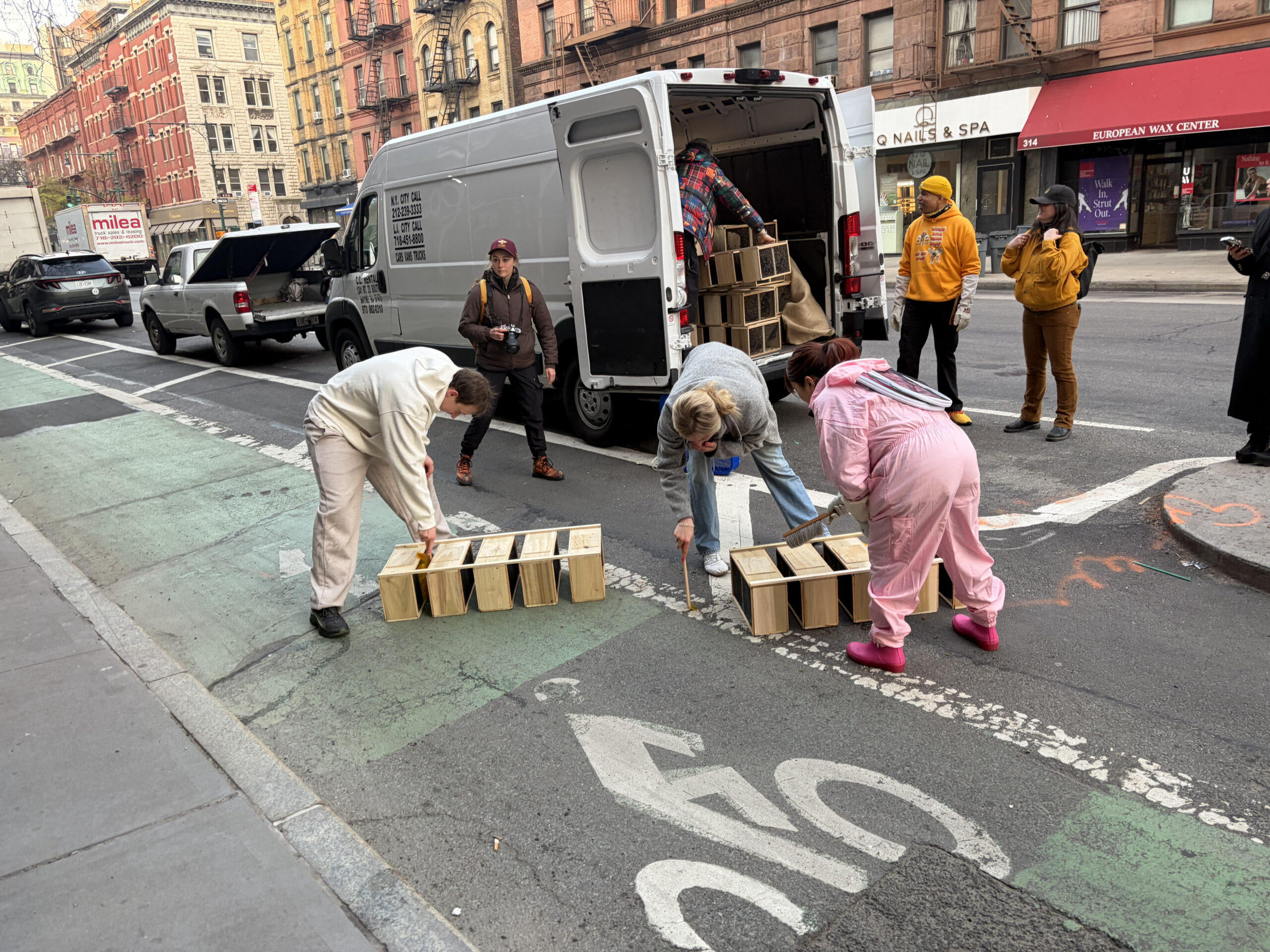
The containers of bees – “a shoe box of 12,000 flying, singing, venomous creatures,” in Coté’s colorful description – were attached together in groups of five. Coté used a reciprocating saw to separate the boxes from one another for distribution.
More than 60 people had signed up to collect a fresh bee colony. “I’m the only guy that I know of in New York City” who sells live bees, said Coté, a fourth-generation beekeeper and founder of the New York City Beekeepers Association.
Coté maintains hives on rooftops and outdoor spaces throughout New York City, including some at landmarks such as Madison Square Garden and the United Nations. But the bees distributed on Friday morning were bred in Georgia, where it’s warmer.
On a phone call with the Rag, Coté energetically explained that “bees are sold by weight, like cheese or cocaine.” A package of three pounds of bees, including a mated queen, is listed on Coté’s website for $210.
Pennie Morgan, director of Hephzibah House, a Christian guest house on West 75th Street, started keeping bees on the building’s roof last spring, with help from Coté’s team. She said that she has become “obsessed” with the bees.
The bees are relatively low-maintenance, she said. Someone from Coté’s team checks up on them around every six weeks, and their honey is harvested in the fall.
If you’re surprised that beekeeping is allowed in New York City, you’re not alone. Coté acknowledged that it catches people off guard to learn that the city legalized beekeeping in 2010 (hives have to be registered with the NYC Department of Health).
As you might expect from someone who spends his life around bees, he downplayed concerns. “People are allowed to reproduce humans, and have dogs, and drive cars, and all of those things are much more dangerous than honeybees,” he said.
Like baking sourdough bread and watching “Tiger King,” beekeeping gained in popularity during the pandemic. There were more than 400 registered hives in NYC as of 2023, NY1 reported.
If the proliferation of hives in the city has gone largely unnoticed, it’s maybe because the bees are too busy searching for nectar and making honey to bother people. Over the course of a year, a colony can produce up to 100 pounds of honey, Coté said.
Morgan said around 15 jars of honey were harvested from her rooftop hives, which she split with Coté and also shared with neighbors.
An average bee lives six weeks, though queens live three to four years on average. Morgan’s bees didn’t survive the winter, which was especially cold. Theoretically, though, the queen can produce new queens, meaning the colony can survive in perpetuity, as long as the queen is healthy.
Cold weather, diseases, and mites can be fatal to bees, but city life is actually quite hospitable, Coté explained. New York provides a diversity of nectar sources, such as the various wildflower meadows in New York City’s parks (conversely, honeybees that are trucked from farm to farm subsist on a monoculture diet). There’s also “little to no spraying [of pesticides] here,” he said, compared to suburban and rural areas that often use chemicals on golf courses, lawns, and farms.
There are more than 200 bee species in New York City, and “having a diverse bee population is important for the city’s ecological health,” according to the NYC Department of Health.
Honeybees may compete with native bee populations for resources, so a good way to support local pollinators, including butterflies, is by planting native plants and reducing the use of pesticides.
Subscribe to West Side Rag’s FREE email newsletter here. And you can Support the Rag here.





Lovely!!! If I had access to a roof I would totally join in
That’s awesome! I don’t even much like honey, but I’m intrigued with bee-keeping. I’m delighted to hear that it is thriving in our fair city.
Did you think about your neighbors who also have accesses to the roof?
The last paragraph is the most important one. There are fewer sources of pollen in a city, and hives of honeybees outcompete our mostly solitary native bees for those resources.
Think carefully before you introduce non-native species to an ecosystem.
Excellent advice, Nancy. Also, check with your neighbors if you’re thinking about keeping bees. I have a ton of pollinator plants which are often abuzz with native bees, but when I asked the owners of the terraces adjoining mine if they’d mind if I became an amateur beekeeper, they both yelled “No way!” So I’ll continue to buy honey at the store or farmers’ market, and maintain friendly relations with my neighbors.
I know there’s little to no pesticide on the wildflowers in the parks, but I’m curious about the rodenticide used in the soil in Central Park and Riverside Park. Does that find its way into the local honey?
Has anyone taken into consideration how frightening this is for people who are allergic to bees???
My father kept bees, and was rarely stung. One of his hives was in our back yard (in California) and they generally ignored people, though occasionally one would “take exception” and chase someone back into the house. They really are gentle, some more than others. (His hives were registered with the county ag department.)
I am allergic to stinging insects, particularly yellow jackets, wasps, etc. I have only ever been stung by the former and, like others, I carry an Epipen “just in case.” (Thankfully, I have never had to use it.) But I also keep myself knowledgeable about stinging insects – and honeybees are literally at the bottom of the list. They are incredibly docile, and rarely, if ever, “attack” unless you attack them first. I only ever see them in the garden at the north end of the Riverside Park promenade (~92nd Street). And they are far too busy collecting pollen to care about ME.
In fact, the “regular” bees that fly around NYC are more likely to sting you than a honeybee. Do you concern yourself with them? Just wondering.
Hi Linda! Honeybees immediately leave their hives flying up to the treetops (which is why you never see a honeybee splatter on a windshield). They are one of the most docile bees and never attack unless you prod around their hive or break it open, which really is almost impossible with man-made hives, or in the wild where they are inside tree stumps or other protected parts, and never in the ground. The biggest risk is stepping on a girl (every honeybee you see foraging is female) out in a field on a clover bloom. But I understand your fear. I’m a beekeeper and allergic to bees!
That is their problem, they should stay away, nobody is forcing them to come close to those bees.
I think the problem is that the bees could come close to YOU! And as someone who is terribly allergic, this reminds me to carry my EpiPen at all times. I do like honey, though.
Nah, that’s not how it works. You don’t get to create a hazard and then act like everyone else is the problem for existing near it.
What?!
What? No stinging rebuttals?
Want butterflies and birds in parks and at your window boxes and block plantings? Plant native plants to attract them. You may even see a hummingbird! Check out this list from the Cornell extension
https://monroe.cce.cornell.edu/master-gardeners/pollinator-friendly-gardens/native-plant-lists
I always wanted to get into Falconry.
Is there a way I could like set that up on my balcony. How badass would that be?
Like some cool hawk would fly around the city and then comeback and land on my arm, covered with one of those leather arm thingy they wear so they don’t get impaled by razor sharp talons.
Wonder how that would go over with the neighbors:)
Love this store – you can always see the active beehives in the front window, like a teeny free natural history museum
Singing or stinging?
This brings to mind an interesting factoid. Actor Morgan Freeman, an avid environmentalist, turned his 124-acros Mississippi ranch into a honeybee sanctuary to do his part in combating the decline of honeybees, which is happening at an increasing rate. He set up 26 hives (with a minimum of 20,000 per hive, that’s over half a million bees, possibly double that). He also planted bee-friendly plants like magnolia, lavender and clover, to give them pollen to collect.
Beekeeping is becoming increasingly popular in the U.S., with some sources suggesting that it has grown 10-fold over the past decade or so.
Most working hives have 50 to 70 thousand bees!
Thank you. I will pass this article along